Serani Hunyi Left Filmmaking for Ten Years. AI Brought Her Back.
For a decade, filmmaker and creative entrepreneur Serani Hunyi stepped away from the film industry. It wasn’t because she had stopped loving cinema. It was because she had stopped feeling excited by it.
SERANI HUNYIBACKSTORYCOLLABORATIONSAI
6/22/2026
A Divided Industry
The arrival of AI has sparked fierce debate throughout Hollywood. Some artists see existential danger. Others see another tool.
Serani understands both perspectives.
“There are legitimate concerns around copyright, authorship, and protecting artists. Those conversations matter,” she says. “But every major technological shift in cinema, from sound to digital cameras to CGI, was met with resistance.”
A growing number of established filmmakers, including Darren Aronofsky, James Cameron, Peter Jackson, Steven Soderbergh, and Natasha Lyonne, have publicly embraced aspects of AI while exploring how the technology might expand storytelling.
The debate remains unresolved. But innovation, history suggests, rarely waits for consensus.
Why Independent Filmmakers Stand to Benefit
For Serani, the excitement surrounding AI isn’t about replacing people. It’s about expanding possibilities.
“Honestly, I don’t know what all the fuss is about,” she says.
AI lowers barriers. It allows smaller productions to think bigger. It stretches limited budgets and gives independent filmmakers access to creative possibilities once reserved for major studios.
For decades, ambitious world-building required enormous resources. Today, those barriers are finally beginning to disappear. And that, Serani believes, changes everything.
Returning for the Revolution
Much has been written about the challenges facing the traditional Hollywood system. But where some see decline, Serani sees reinvention.
“The system as we know it is changing,” she says. “And I think this might be the most exciting time in decades to be making films.”
After ten years away from the industry, she has returned with renewed passion. CALIBRATION represents more than a return to filmmaking. It marks the beginning of a new creative chapter. Not because Serani believes artificial intelligence will replace artists. Quite the opposite.
“The human element remains the soul of cinema,” she says. “Technology changes. Tools change. But storytelling has always been about people.”
For Serani Hunyi, the arrival of AI does not signal the end of filmmaking. It signals the beginning of something new.
And for the first time in years, she says she couldn’t be more excited to be back.
Read about Serani's AI Collaborator on CALIBRATION, Claudia Lalau from France
Read about the CALIBRATION Collaboration between Serani Studio and Bottomline AI
FOLLOW CALIBRATION:
Serani Hunyi Left Filmmaking for Ten Years. AI Brought Her Back.
For a decade, filmmaker and creative entrepreneur Serani Hunyi stepped away from the film industry.
It wasn’t because she had stopped loving cinema. It was because she had stopped feeling excited by it.
After decades working across film, music videos and commercial production, Serani increasingly felt that the industry had become creatively stagnant. Technology was advancing, but genuine disruption seemed absent. The tools were evolving incrementally, yet filmmaking itself felt largely unchanged.
She made a conscious decision to step away. Instead, she immersed herself in technology, tech investment, sustainability, and other interesting verticals, convinced that if cinema experienced another major shift, she would return.
“I knew that if and when the industry changed, I’d come back,” she says. “I just didn’t know what that change would look like.”
That moment arrived when she first encountered OpenAI’s Sora. Suddenly, the excitement she had felt as a young filmmaker returned.
“It felt like the disruption I had been waiting for.”
Discovering a Fellow Pioneer
About a year ago, Serani first encountered the work of French filmmaker and AI pioneer Claudia Lalau after a connection on LinkedIn shared one of her projects.
Intrigued, she followed Lalau’s work closely. Their paths crossed again inside an AI filmmaking community on Skool, where Lalau was also a member. Serani became a regular viewer of Lalau’s YouTube channel, where the AI filmmaker openly shares her experiments and techniques.
Despite admiring Lalau’s work, Serani hesitated to make contact, thinking the filmmaker behind Bottomline AI would have little interest in collaborating.
She was wrong.
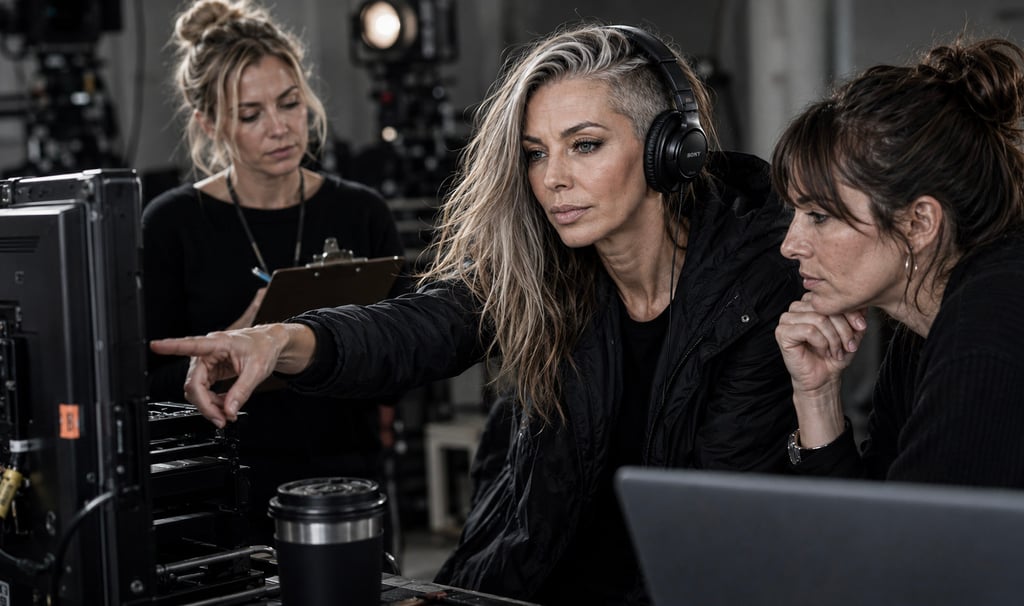
When the two women finally met over Zoom, they discovered a shared enthusiasm for the future of filmmaking. When Lalau agreed to join CALIBRATION as AI directing partner, Serani describes the moment as “everything falling into place.”
Neither Traditional Nor Artificial
Most discussions around AI filmmaking present a binary choice. Traditional filmmaking or AI.
But CALIBRATION occupies a space somewhere between the two.
The production combines human performances, practical locations, and traditional cinematography with AI-assisted world-building and visual expansion.
No AI actors. No AI-written screenplay. No synthetic performances. Instead, the film embraces a hybrid workflow that uses emerging technology to extend what independent filmmakers can accomplish.
To Serani's knowledge, CALIBRATION may be among the first narrative productions in Prague being produced by local filmmakers to experiment with this type of hybrid approach.
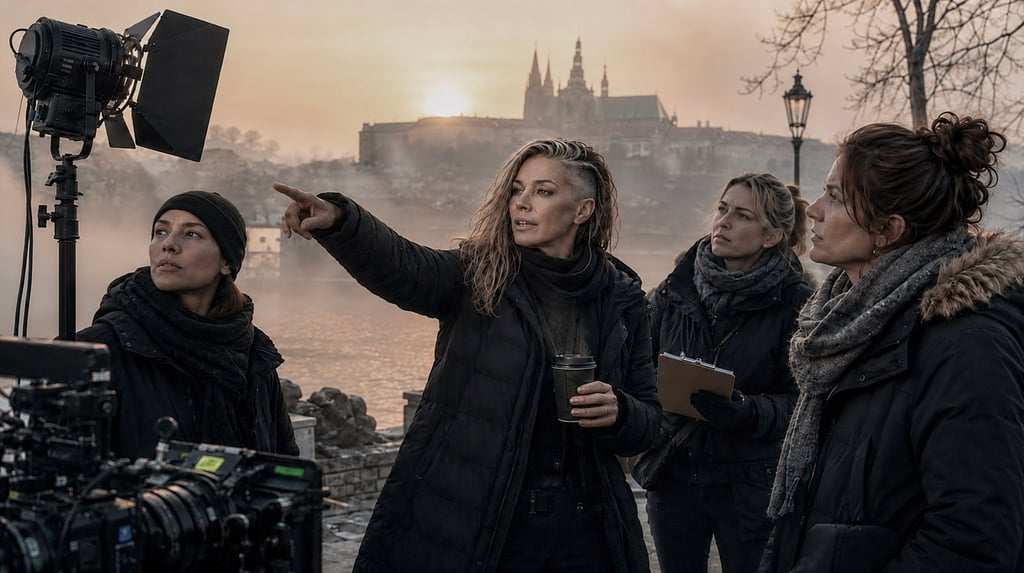
For Serani, the excitement surrounding AI isn’t about replacing people. It’s about expanding possibilities.
Reach out for interviews or collabs
© 2026. All rights reserved.
CALIBRATION is produced by Serani Studio (Prague), in association with Bottomline AI (France)